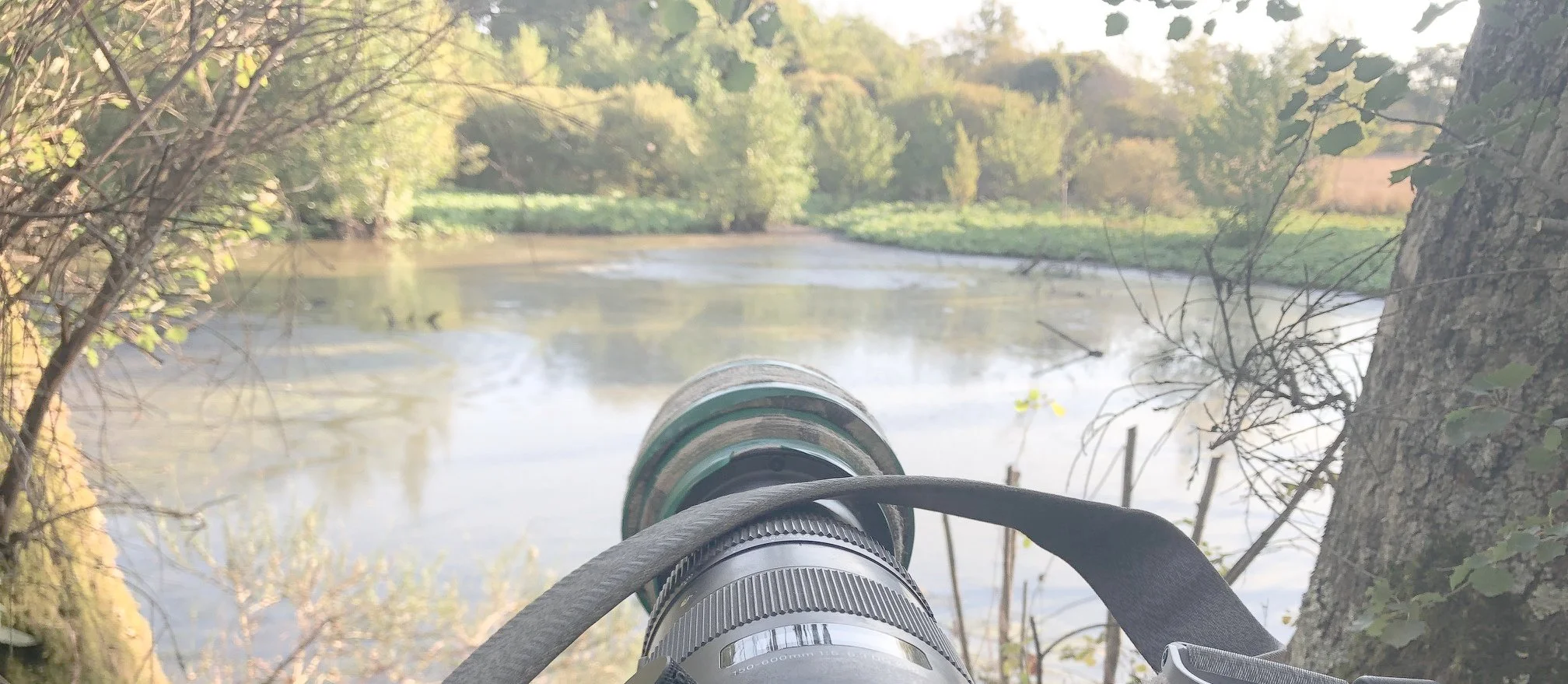
Life In A French meadow
Nature photography in rural France
I am very lucky to live in a beautiful region of France, the Haute Vienne, having escaped from the UK along with my wife several years ago. Along with the house we own about 1Ha of land which I regard as my personal nature reserve and photographic studio.
Photography has been my passion for over 50yrs and nature photography combines it with my other lifelong passion wildlife. On this blog I hope to share these passions and also explain techniques, experiences and also discuss the subjects of my photographs, I am as interested in their Biology and Ecology as I am in photographing them.
Gary
Parasitic flies
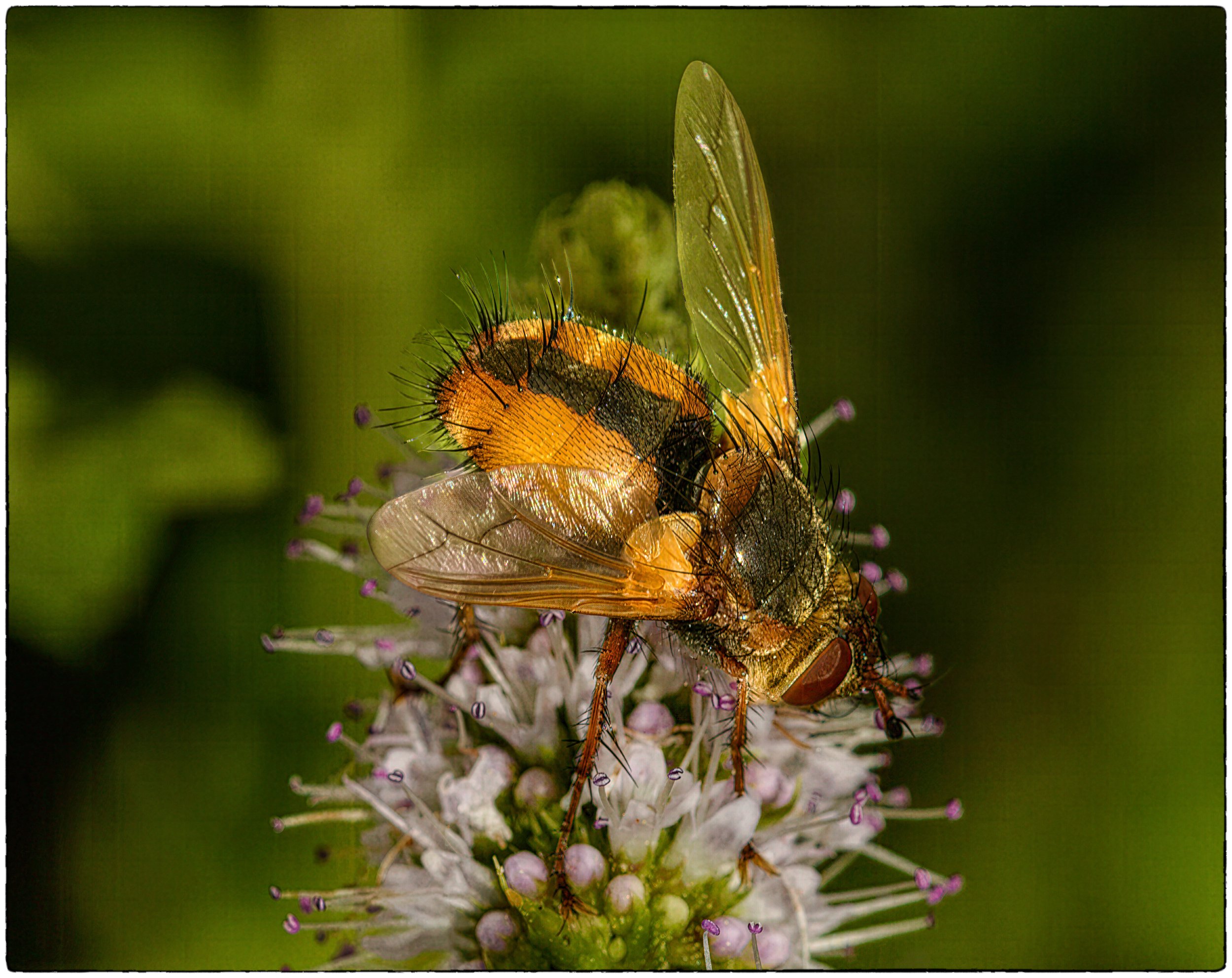
Tachina fera (commonly known as the common tachinid fly) is a large, distinctive species of parasitic fly. It belongs to the family Tachinidae within the order Diptera (true flies).
Tachina is a genus of large flies in the family Tachinidae. There are approximately 600 species worldwide. Most have larvae that are parasitoids of lepidopteran caterpillars.
Tachina fera is a fascinating dipteran whose larval stage plays a parasitic role, typically infesting caterpillars. As an adult, it exhibits a distinctive hairy appearance with patterns that enable it to blend seamlessly into its surroundings. Renowned for its contribution to controlling pest populations, this species showcases the intricate balance of symbiosis and predation within its ecosystem.
The body is heavily covered in stiff, prominent black bristles (bristle-backed), especially near the tip of the abdomen. The bristles act primarily as mechanosensory organs called bristle sensilla. Each bristle connects to a sensory neuron that detects physical deflection when touched by air currents, dirt, or objects, helping the fly monitor its environment, coordinate posture, and trigger reflexive behaviors like grooming.
Thanks to Wikipedia for the additional information, Diptera are not my specality. Scorpion flies
Read my latest blog on Scorpion flies, a fascinating ancient group of insects.
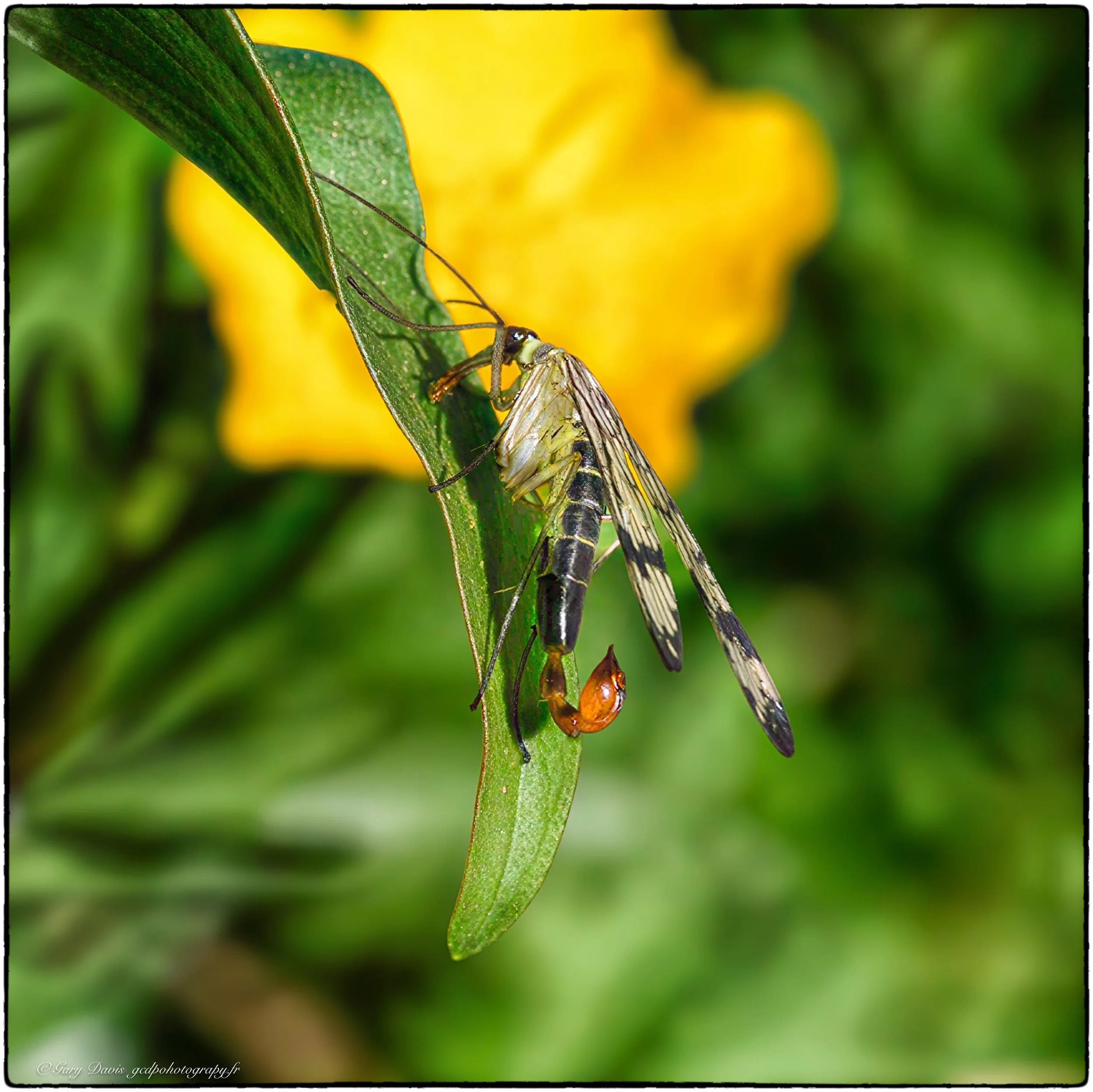
Scorpionflies are members of the Mecoptera are named after their largest family, Panorpidae, in which the males have enlarged genitals raised over the body that look similar to the stingers of scorpions, and long beaklike rostra used for feeding. Although the “sting” looks impressive it is totally harmless
Scorpionflies, family Panorpidae, generally live in broad-leaf woodlands with plentiful damp leaf litter. They mostly breed among mosses, in leaf litter and other moist places, but their reproductive habits have been little studied, and at least one species, Nannochorista philpotti, has aquatic larvae.
Adult mecopterans are mostly scavengers, feeding on decaying vegetation and the soft bodies of dead invertebrates. They are also important insects in forensic science as they are often some of the first insects to invade corpses. Panorpa also raid spider webs to feed on trapped insects and even the spiders themselves. Some groups consume pollen, nectar, midge larvae, carrion and moss fragments.
The order Mecoptera are an extremely ancient group of insects, persisting relatively unchanged for more than 250 million years. The earliest fossils, predating the age of the dinosaurs, already show a close resemblance to modern-day species, and, as the apparent ancestor of butterflies, moths, true flies and fleas, the group occupies an important place in the history of insect evolution.
Ruddy Darter, Ruddy dogs
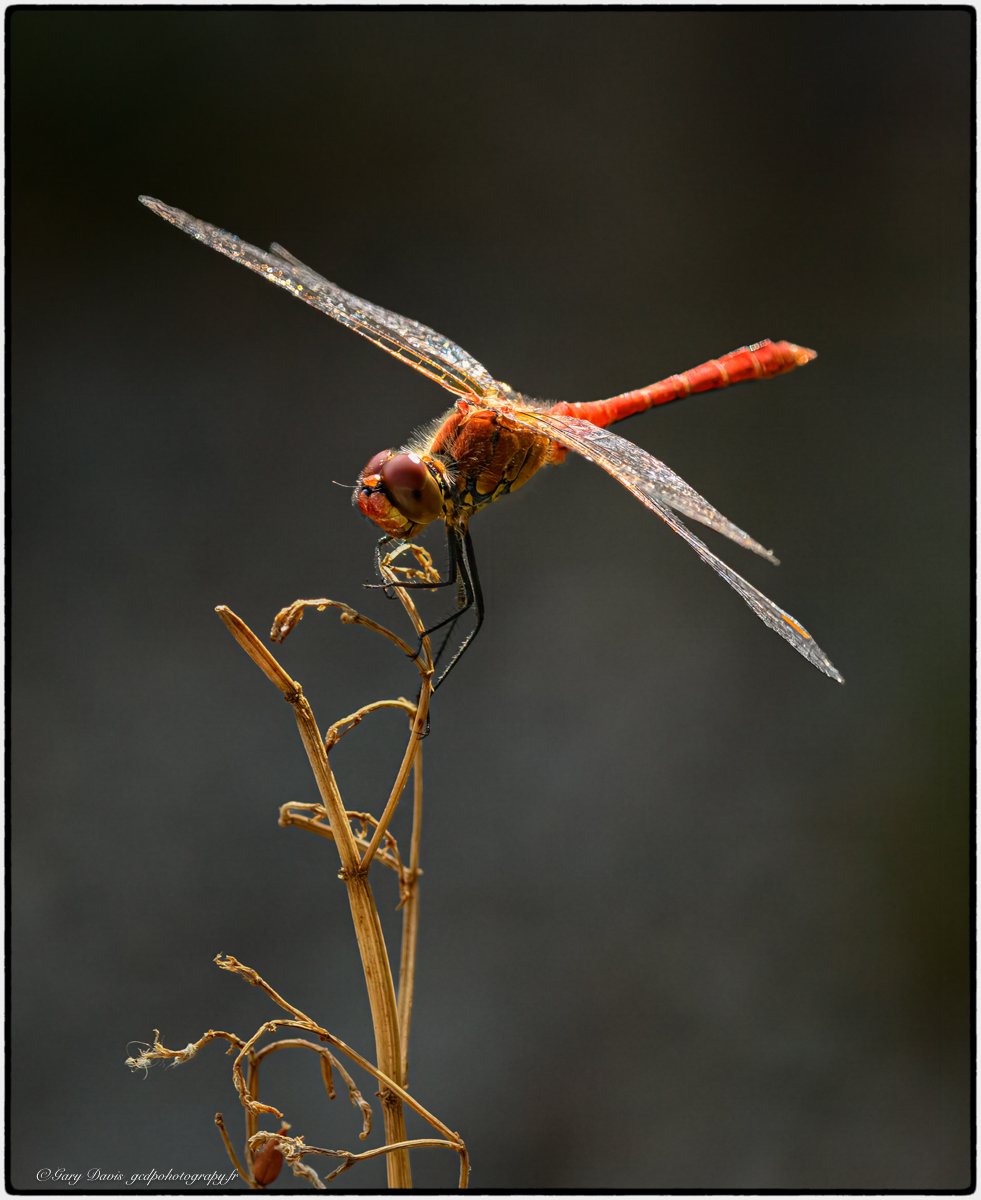
This Ruddy darter (Symptrum sanguineum) was resting on this dead stem when the ruddy dog decided that it was a great time to run throught the plant !!! The result was I only managed to get 2 shots.
This year has not been good for dragonflies, the canicule here in France has resulted in extreme heat in this region, tempratures exceeding 40c. This has caused ponds and other wetland ares to dryout before many species had transitioned from the aquatic laveal stages. The Ruddy darter larvae like to live among the roots of Horsetails (Equisetum) nand Bulrushes (Typha) in boggy ground. On our land we have a couple of old ponds that are overgrown and shaded which provide ideal conditions for them and have actually remained largely damp. The eggs themselve are drought resistant not hatching until covered by water.
When they do emerge their flight season is quite long, extending into late autumn. In fact the season seems to be limited by food supply rather than cold weather.
This photo was handheld, Nikon D850, f11, 1/500 sec with the camarea set on manual and Auto iso enabled
Little and Large
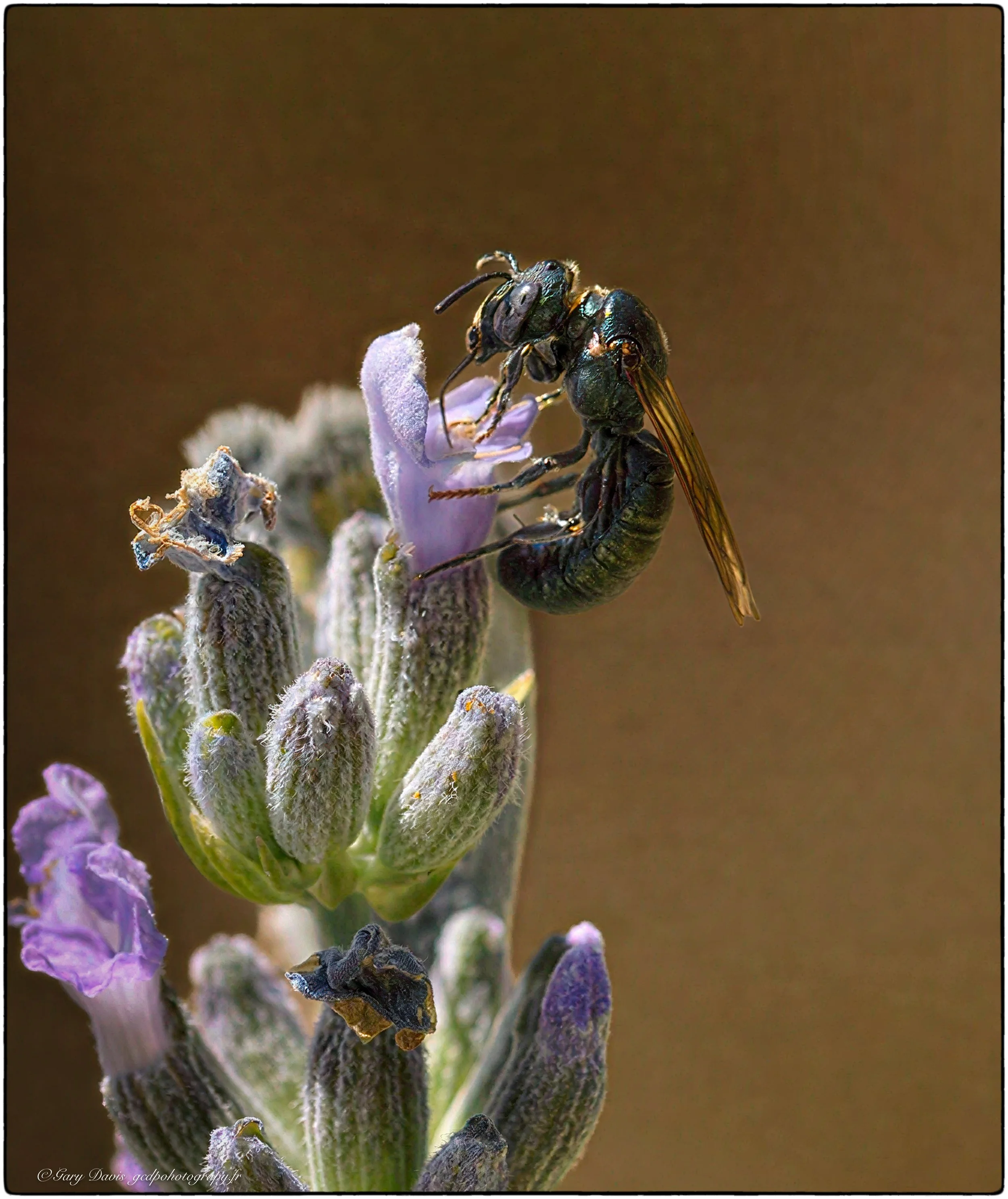
This tiny bee is the Little blue carpenter bee Ceratina Cyanea feeding on a lavender flower in our garden. This was a new species to me and I had to get some expert help from an online entomology group to identify it, as you can see it is only a few mm long. Although the lavender was alive with them they are in fact solitary bees, they get their common name from their nesting habits, building their nest inside dead stems, preferably brambles and umbellifers (Hogweeds etc), The female burrows along the inside of the stem forming a tube, then works her way back out laying eggs in sealed cells as she goes. These eggs will hatch and the hatchings will stay in the stem over winter emerging in the spring as bees to mate and continue the cycle.
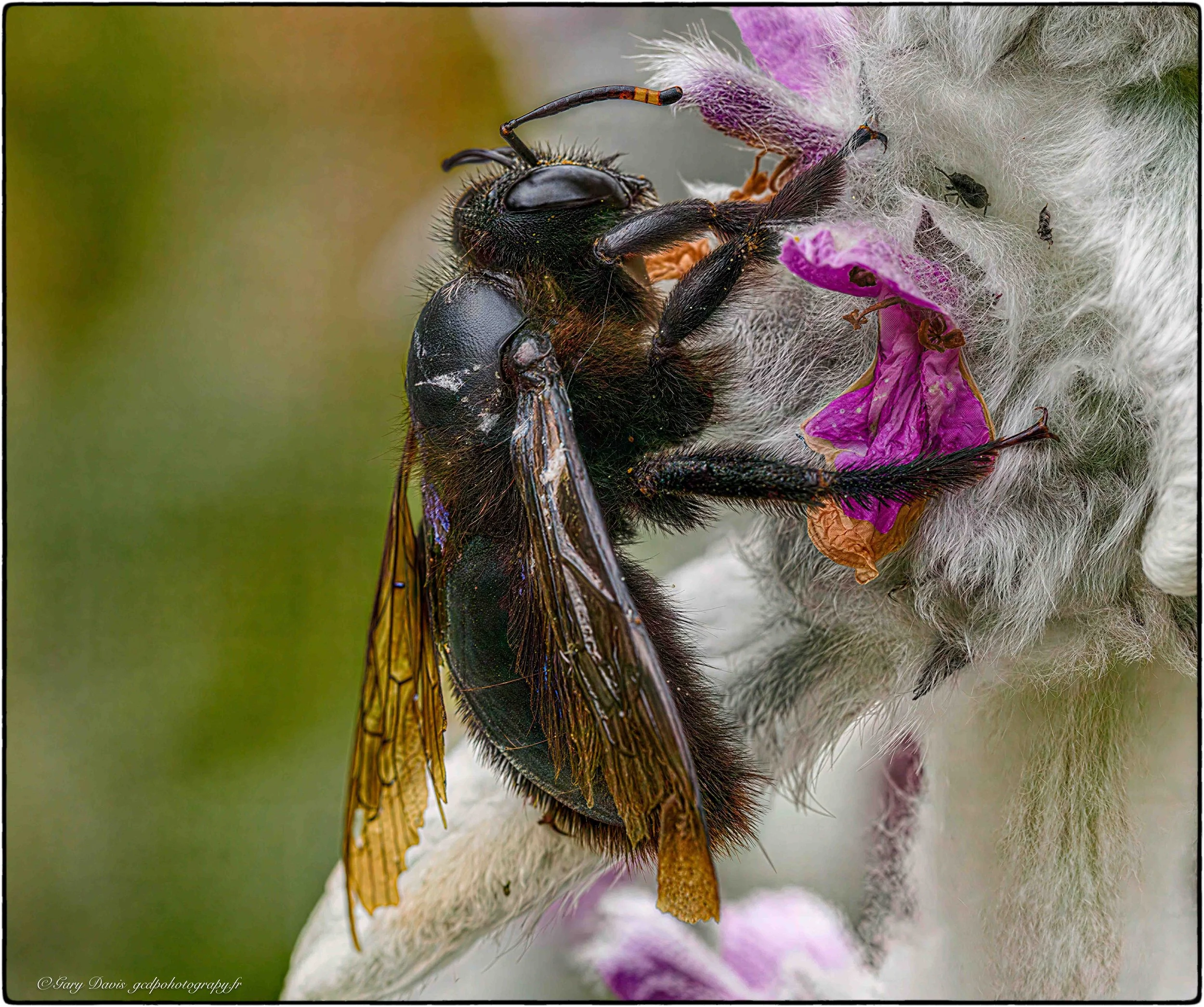
Xylocopa violacea, Violet Carpenter bee
The second bee is the Violet carpenter bee Xylocopa violacea In contrast to Ceratina these are large bees, in fact the largest European species although both are related as members of the family Xylocopinae Xylo = wood Copo = Cut. Xylocopa is one of the commonest bees in our garden in early summer (and one of the loudest). They get their common name from their ablity to bore galleried nests into old wood creating cells from the chewed wood. Unfortunatly they cannot distinguish between dead trees and old timbers on houses and quite often get blamed for damage ( although far more is caused by wasps and hornets). The one in the photograph is quite an old individual as you can see from the damage to the wings and the marks on the back of the scutum ( the plate on the back of the Thorax). When they mate as part of the ritual they approach each other and touch together the orange bands on their antenae, then vibrate their bodies vigorously ( and loudly) before mating.
In terms of Ecology and Biodiversity both these species demonstrate the importance of not always cutting back dead plants and old wood in a garden as the material you remove and destroy may well be full of overwintering insect lavae.
The Ceratina was photographed hand held with a sigma 105mm + 1.4 converter I set the shutter and aperture manually and the ISO to auto iso 220 f10 1/640. The Xylocopa was captured with the 105mm but the camera was setup on a tripod, these bees tend to settle on a flower and spend some time on it allowing you to position a camera. I still used the technique with the auto ISO as I needed to freeze the insect ( they are constanly moving or vibrating) and get a large depth of field. ISO 2000, f18, 1/400sec d. Neither species are in the slighest bit aggressive so getting in close is not a problem
Don’t chase Hoverflies
Hoverflies, short lived masters of the air
Hoverflies are amazing creatures, they are absolute masters of the air defending their territory against rivals in their quest to mate. On average they only live for about 12 days although some species can live up to 40 days. They actually spend most of their lives as lavae; 40% of the known lavae predate Aphids, so they really are a gardner’s friend.
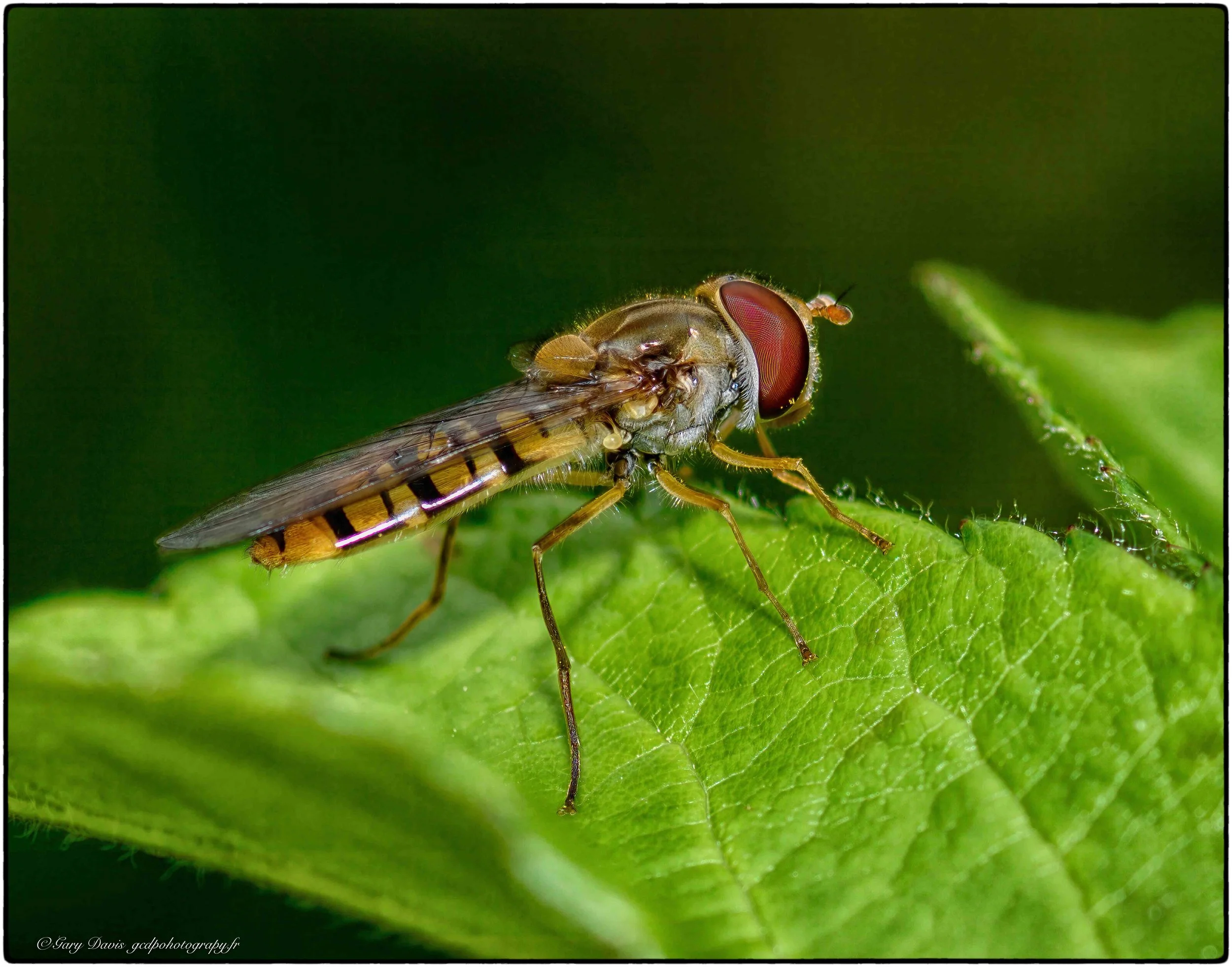
The adults lack any specialised mouthparts so feed on nectar and pollen on the surface of flowers or on the surface of leaves like the one in the photograph, Epistrophe nitidicollis, where they also find Honeydew, a secretion from aphids. The lack of specialised feeding reflects the fact that the sole purpose of the fly life stage is to mate, and so the insect needs to gather energy rich food rapidly from any available source.
Like all flies they have modified hind wings; these are reduced to a pair of Halteres, small stems with a knob on the end. You can see these in the photograph as small pale stems where the main wings join the body. These vibrate with the wings and act as balance organs allowing steady flight. The insect twists them to change direction and the body adjusts orientation, to keep them level like a gyroscope in a boat.
The territorial habit of hoverflies helps when photographing them. If you spend time watching them you can identify spots where they return to land as was the case here ( also works for Dragonflies). This allowed me to setup a tripod and camera, and stake out the leaf waiting for the insect to return. This works well as like all flies they are very sensitive to movement and with the camera fixed you are less likely to disturb them. The camera was a Nikon D850 and a 105mm macro set at f7 1/200 sec using natural light.
Western Honey Bee
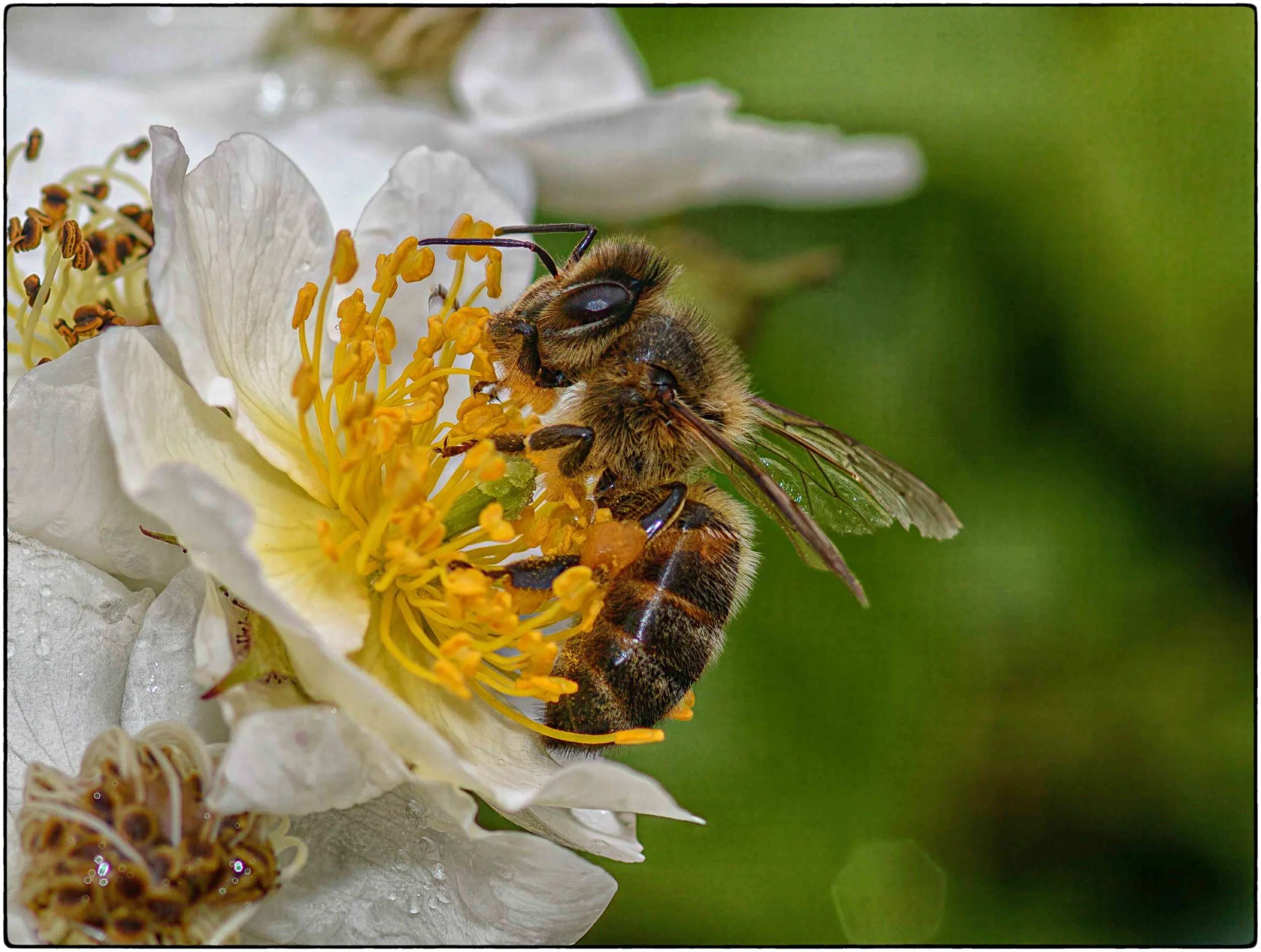
Western Honey bee Apis mellifera
"The bee is an insect admired for its industriousness, its economy and its way of working for the common good." — Charles Darwin
The Western Honey bee Apis mellifera one of a group of 7 honey bees world wideis probably the most well known and studied insect on the planet, it is also one of the easiest to photograph. This one was feeding on a wild rose in the garden. To photograph it I used a 105mm macro lens on my Nikon D850, the shot was handheld at f7, 1/200 sec at ISO 250
Due to their abundance little actual fieldcaraft is needed to photograph them but a little knowledge does help. If you observe a bee feeding on a flower and fly off the temptation is to setup the camera and wait for it or another bee to return, don’t, it won’t, at least not for a while. You may see bees fly up to the flower but yhey will probably not land, the bee and other bees will know that flower has been emptied of nectar. So how do bees know this? Well bees have smelly feet, they screate semiochemical such as pheromones that mark the plant, other bees will detect these using chemoreceptors on the antennae and legs and avoid that flower. The chemicals will gradually decay a process that roughly corresponds to the time it takes for the flower to create new nectar. This ‘labelling’ system is also true for other insects such as butterflies.
Apis mellifera is Polylectic meaning it feeds on a large variety of flowers, it prefers open flat flowers such as this rose as it has a short proboscis (feeding tube) not suited to deep tubular flowers such as foxglove Digitalis purpurea or tomatos which are more suited to bunble bees.
The honey bee is unusual in the world of bees in that it forms large colonies which survive over long periods of time, something it shares with it’s distant relatives the Ants. There are at least 20,000 different species of bee world wide and apis is unique in this. Beesand Ants evolved from wasps and all 3 groups form the family Hymenoptera. So bees can be descibed as vegetarian wasps. Wasps and Hornets of course do buld large colonies but these tend to only survive a single season wheras a hive of honey bees can survive many years as generations of queens are replaced.
Some background
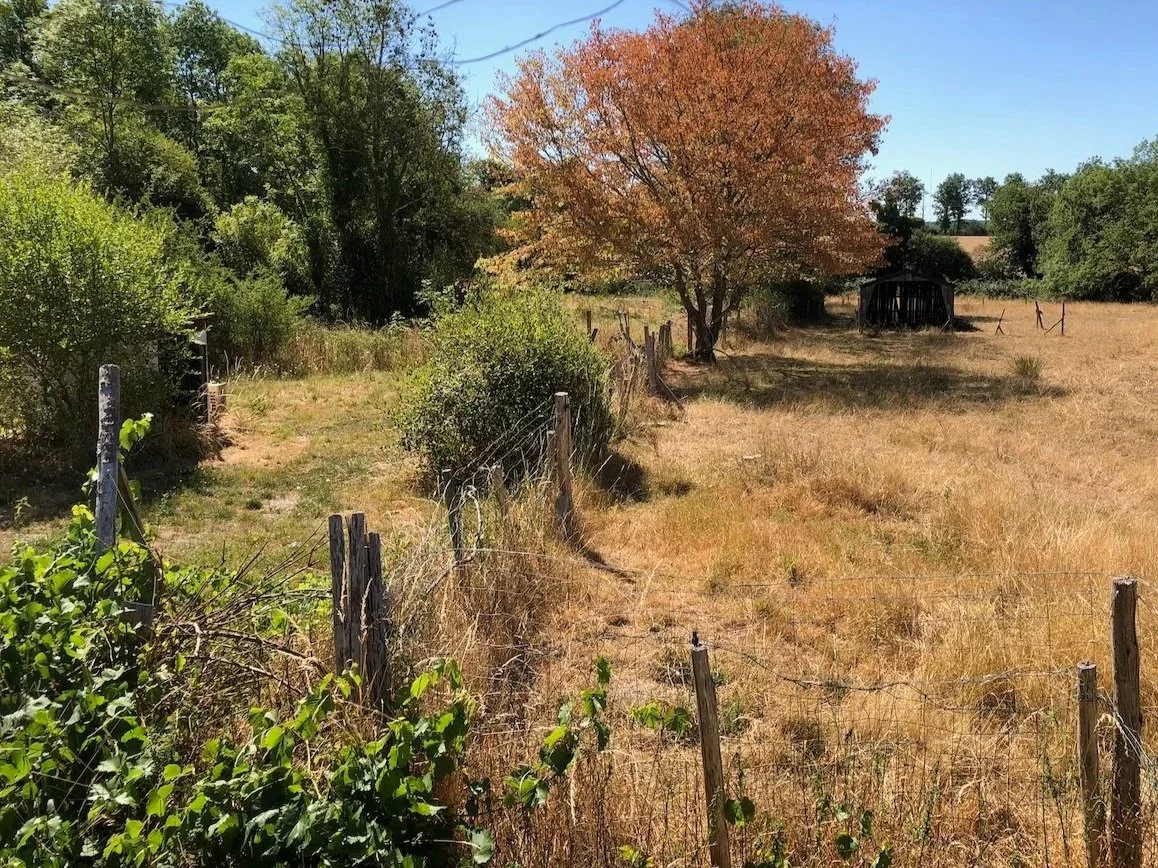
We moved to France from the UK in July 2019 it was something we had always wanted to do and we wanted to escape before Brexit took affect. The area we chose is in the Haute Vienne, about midway down France about 70km north of Limoge. Along with the house we aquired some land, about 1Ha of rough pasture which I divided into two parts, one I use as summer grazing for Pru our donkey, the other half I leave wild for plants and insects during the summer and open it for winter grazing when we need it. Allowing Pru to graze the meadow allows the natural spread of seeds pre mixed with fertiliser.
The meadow is my outdoor studio and much of my nature photography is done there, in the summer I concentrate on invertebrates and plants, in the winter I spend my time photographing birds. This area of France is mainly forested with lots of lakes and several large rivers giving access to lots of alternative sites when I want to venture out.
As you can see from my main website gcdphotography.fr I do not only do nature photography, but wildlife and nature have always been a passion. I studied Biology at university and have been taking photographs for over 50 years, I worked as a photography technician when I left school but I actually had my first camera when I was in my early teens and helped my dad process prints in the kitchen even before that.
These days I work with Digital (Nikon) and process my images on a Mac, but the principles are the same as when i worked with film in the darkroom, you still need an understanding of how the camera works with various lenses, and an appreciation of the rules of composition and of light. With nature you also need some fieldcraft skills and an understanding of the animals you are photographing, their habits, food sources etc, this comes with practice and good observational skills. Unlike most other genre of photography a good chair, flasks of coffe anf a lot of cammoflage gear are also very useful..
I hope in this blog to explain how I work, share experiences and to pass on knowledge to help others to get more out of their own work. I also welcome feedback to help me improve my work. But mainy I just want to enjoy myself.