Life In A French meadow
Nature photography in rural France
I am very lucky to live in a beautiful region of France, the Haute Vienne, having escaped from the UK along with my wife several years ago. Along with the house we own about 1Ha of land which I regard as my personal nature reserve and photographic studio.
Photography has been my passion for over 50yrs and nature photography combines it with my other lifelong passion wildlife. On this blog I hope to share these passions and also explain techniques, experiences and also discuss the subjects of my photographs, I am as interested in their Biology and Ecology as I am in photographing them.
Gary
Parasitic flies
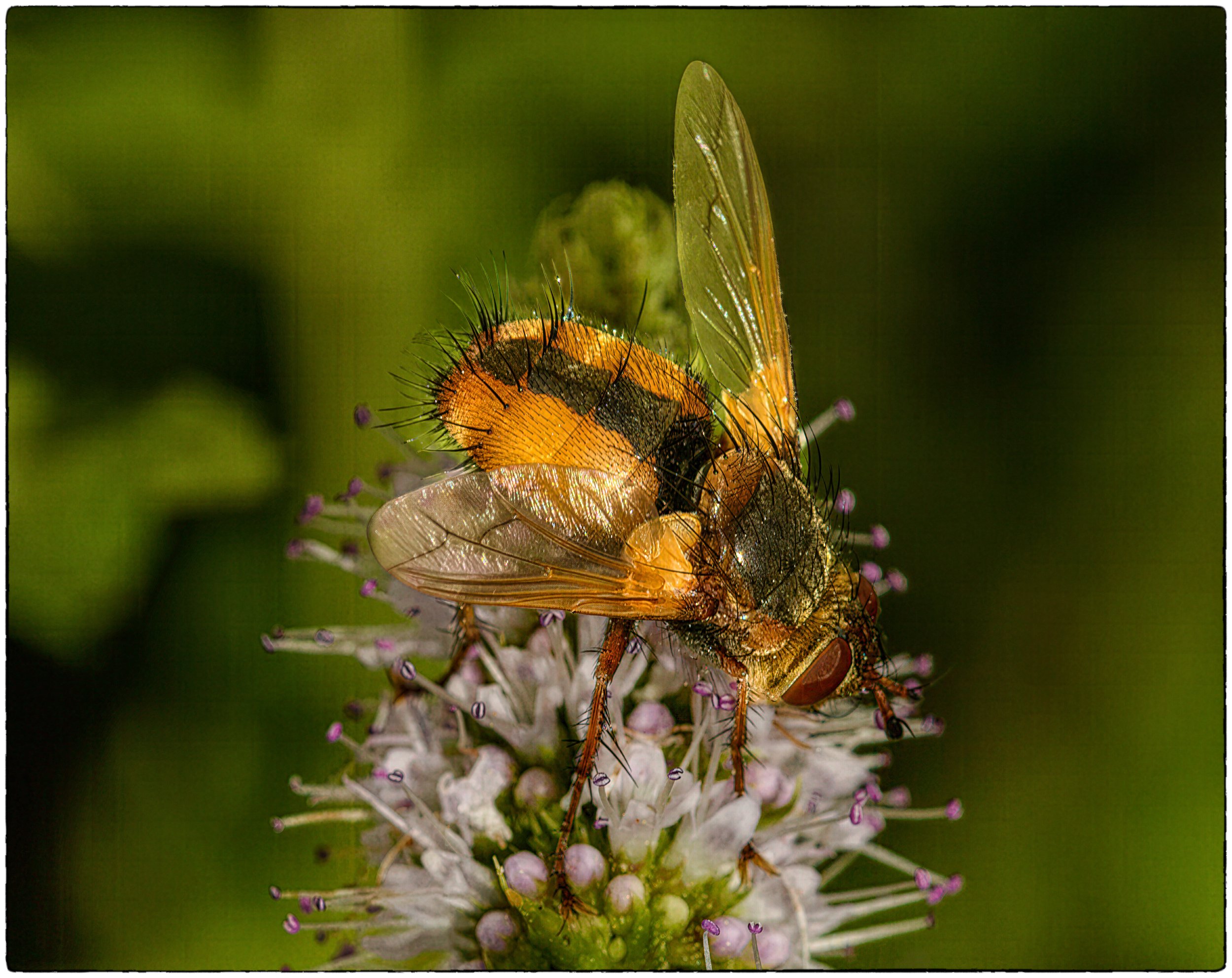
Tachina fera (commonly known as the common tachinid fly) is a large, distinctive species of parasitic fly. It belongs to the family Tachinidae within the order Diptera (true flies).
Tachina is a genus of large flies in the family Tachinidae. There are approximately 600 species worldwide. Most have larvae that are parasitoids of lepidopteran caterpillars.
Tachina fera is a fascinating dipteran whose larval stage plays a parasitic role, typically infesting caterpillars. As an adult, it exhibits a distinctive hairy appearance with patterns that enable it to blend seamlessly into its surroundings. Renowned for its contribution to controlling pest populations, this species showcases the intricate balance of symbiosis and predation within its ecosystem.
The body is heavily covered in stiff, prominent black bristles (bristle-backed), especially near the tip of the abdomen. The bristles act primarily as mechanosensory organs called bristle sensilla. Each bristle connects to a sensory neuron that detects physical deflection when touched by air currents, dirt, or objects, helping the fly monitor its environment, coordinate posture, and trigger reflexive behaviors like grooming.
Thanks to Wikipedia for the additional information, Diptera are not my specality. Little and Large
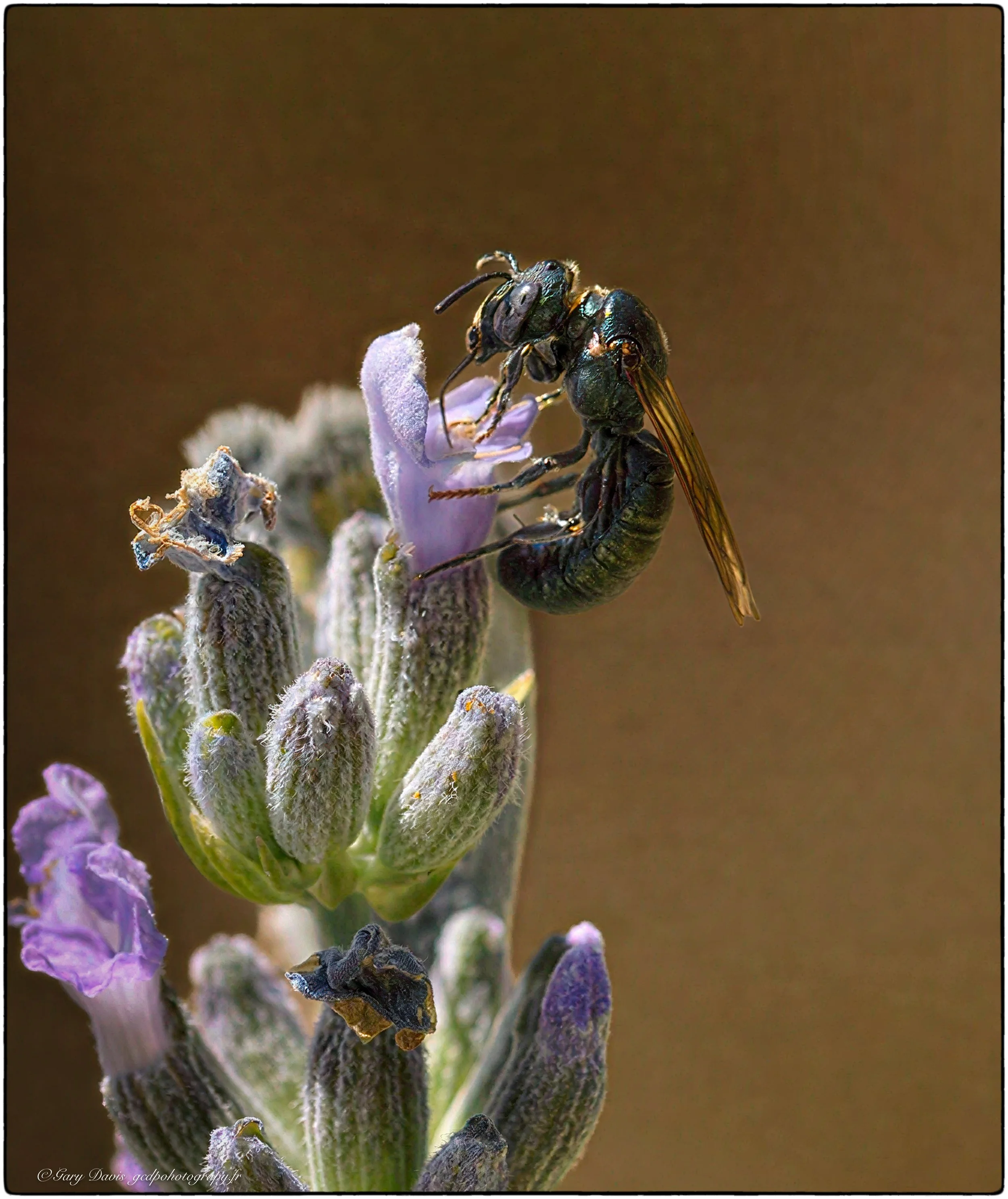
This tiny bee is the Little blue carpenter bee Ceratina Cyanea feeding on a lavender flower in our garden. This was a new species to me and I had to get some expert help from an online entomology group to identify it, as you can see it is only a few mm long. Although the lavender was alive with them they are in fact solitary bees, they get their common name from their nesting habits, building their nest inside dead stems, preferably brambles and umbellifers (Hogweeds etc), The female burrows along the inside of the stem forming a tube, then works her way back out laying eggs in sealed cells as she goes. These eggs will hatch and the hatchings will stay in the stem over winter emerging in the spring as bees to mate and continue the cycle.
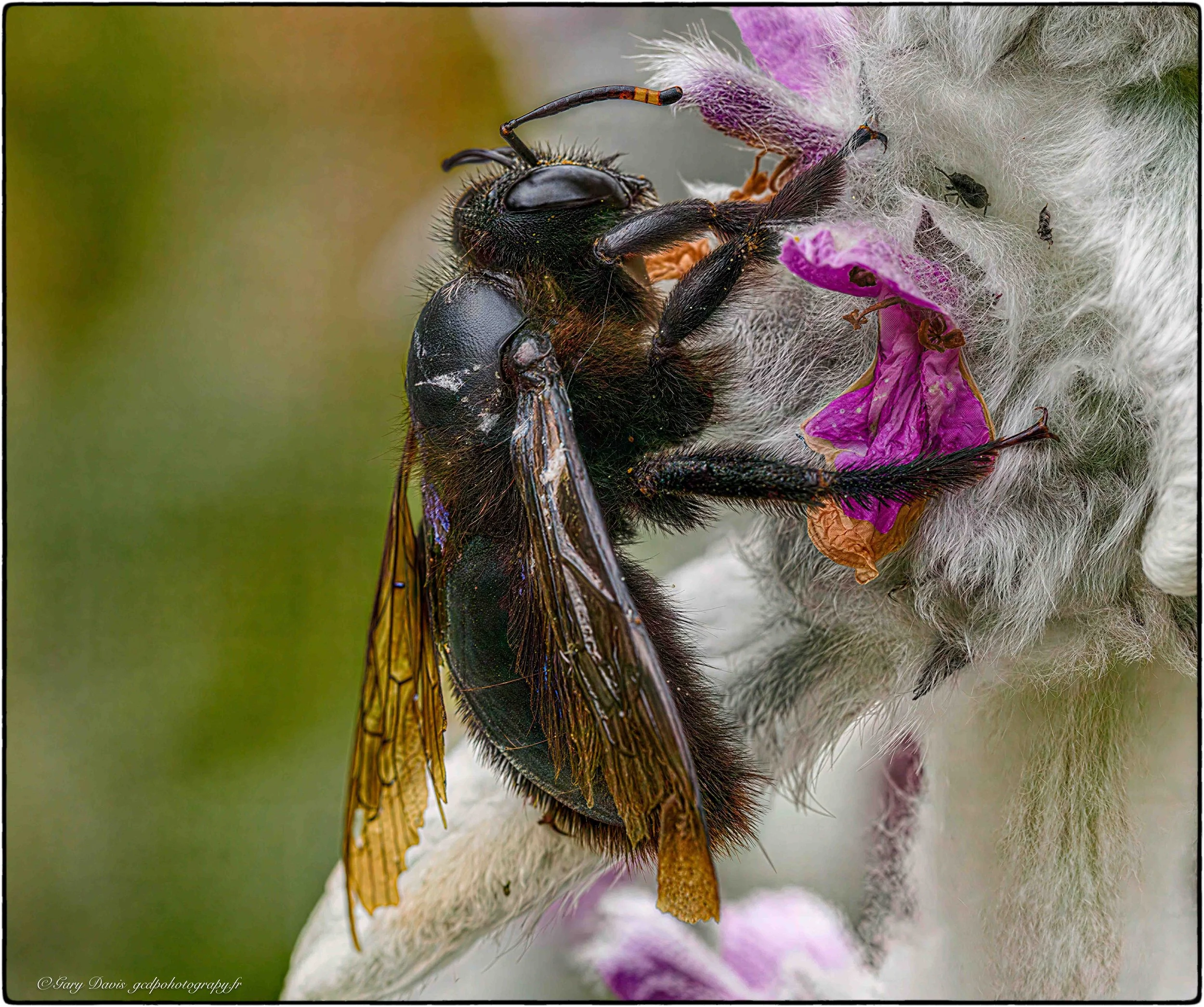
Xylocopa violacea, Violet Carpenter bee
The second bee is the Violet carpenter bee Xylocopa violacea In contrast to Ceratina these are large bees, in fact the largest European species although both are related as members of the family Xylocopinae Xylo = wood Copo = Cut. Xylocopa is one of the commonest bees in our garden in early summer (and one of the loudest). They get their common name from their ablity to bore galleried nests into old wood creating cells from the chewed wood. Unfortunatly they cannot distinguish between dead trees and old timbers on houses and quite often get blamed for damage ( although far more is caused by wasps and hornets). The one in the photograph is quite an old individual as you can see from the damage to the wings and the marks on the back of the scutum ( the plate on the back of the Thorax). When they mate as part of the ritual they approach each other and touch together the orange bands on their antenae, then vibrate their bodies vigorously ( and loudly) before mating.
In terms of Ecology and Biodiversity both these species demonstrate the importance of not always cutting back dead plants and old wood in a garden as the material you remove and destroy may well be full of overwintering insect lavae.
The Ceratina was photographed hand held with a sigma 105mm + 1.4 converter I set the shutter and aperture manually and the ISO to auto iso 220 f10 1/640. The Xylocopa was captured with the 105mm but the camera was setup on a tripod, these bees tend to settle on a flower and spend some time on it allowing you to position a camera. I still used the technique with the auto ISO as I needed to freeze the insect ( they are constanly moving or vibrating) and get a large depth of field. ISO 2000, f18, 1/400sec d. Neither species are in the slighest bit aggressive so getting in close is not a problem